Your Guide to FishHawk Ranch Villages and Amenities
May 21, 2026
May 21, 2026
Wondering how FishHawk Ranch is actually set up? You are not alone. Many buyers hear the community name, see the amenities, and assume it works like one neighborhood with one set of rules, but FishHawk Ranch is more layered than that. Once you understand how the villages, trails, amenities, and associations fit together, it becomes much easier to decide which part of the community may suit your goals. Let’s dive in.
FishHawk Ranch is best described as a large master-planned district, not just a single subdivision. According to the FishHawk Ranch Community Development District, or CDD, it was formed in 2019 by merging three earlier districts and now covers about 2,562.810 acres with a 5,026-unit residential and commercial mix.
That larger district structure matters because the CDD handles major shared features across the community. Those include stormwater facilities, wetlands, entryway monumentation, collector-road landscaping, neighborhood parks, trails, and recreational amenity areas.
At the same time, FishHawk Ranch is also shaped by multiple associations. The CDD states that the community is represented by two main HOAs plus smaller associations, which means rules, maintenance responsibilities, and amenity access can vary depending on the section you are considering.
When people talk about FishHawk Ranch, they are often really talking about one of its smaller village areas. The public trail guide is one of the clearest ways to see how the community is organized internally, naming areas like Eagle Ridge, Heron Glen, Kestrel Ridge, Vireo Ridge, the Bridge villages, Tern Wood, Starling, Osprey Ridge, Dorman, and Hawk Park.
In practical terms, these village names help you understand the day-to-day feel of a home’s location. Some sections are closely tied to trails, some connect more directly to parks or courts, and others sit nearer to clubhouse-style amenity spaces.
This is one reason two homes in FishHawk Ranch can feel very different even if they share the same broader community name. The village location may affect your access routes, nearby recreation options, and how connected your home feels to the rest of the district.
One of the most useful parts of FishHawk Ranch is how the trail system links different parts of the community. The trail guide shows that these paths are not just recreational loops. They also help connect residents to amenities and practical destinations.
For example, the Tern Wood loop reaches local retail. The Hawk Park trail connects residents to the sports complex and activity fields and courts. The Osprey Ridge and Dorman loop links to the Aquatic Club and the Dorman Road boardwalk.
There is also a FishHawk Boulevard trail corridor that connects shopping areas from Lithia Pinecrest Road to Bell Shoals Road. For buyers, this means the trail network can be a real quality-of-life feature, especially if you want easier access to recreation or nearby services without always getting in the car.
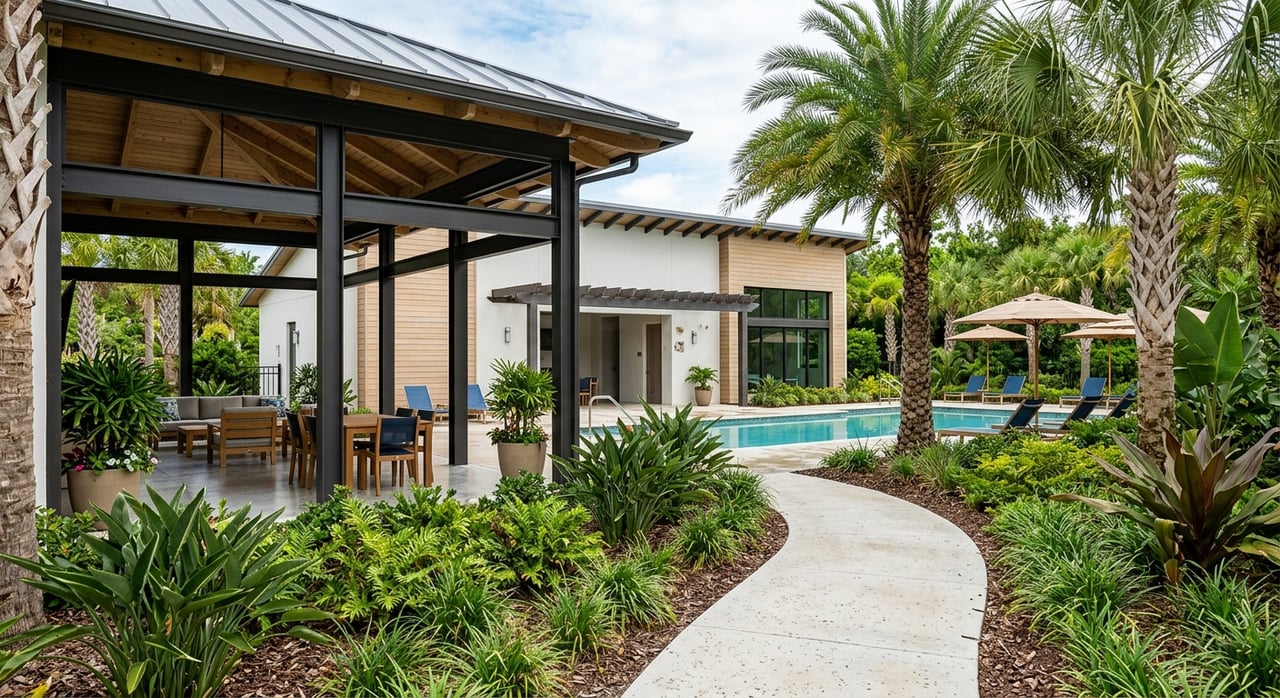
FishHawk Ranch has a broad amenity system, but it is better understood as a network of smaller activity hubs rather than one central clubhouse. The CDD amenities page lists a wide range of shared features, including the FishHawk Ranch Tennis Club, pools and aquatic features, basketball courts, a roller hockey court, the Hawk Park softball field, tennis and pickleball courts at Hawk Park and Osprey Club, playgrounds, multiple fitness centers, the Starling Club game room, and Starling dog parks.
That spread-out layout can be a big advantage because different parts of the community tie into different amenity clusters. Instead of everything centering around a single building, residents use a mix of clubs, parks, and recreational spaces throughout the district.
The community also includes reservable gathering spaces. The facility rentals page shows residents can reserve the Aquatic Club, Osprey Clubhouse, Osprey Theater, Starling Club and Game Room, Tennis Club, and Palmetto Club for private events.
Park Square adds another layer to the amenity mix with its interactive water feature and shared community-space role. Altogether, the setup gives FishHawk Ranch a village-based feel, where social and recreational activity happens across multiple nodes.
A key detail for buyers is that amenity access is controlled, not automatic in a casual sense. The district newsletter states that amenity access cards are required for pools, fitness centers, athletic courts, and ponds, and those cards are tied to the named patron.
That may sound small, but it is an important part of how the community operates. If you are comparing homes in different sections, you will want to confirm exactly what access comes with that property and whether any nearby facilities are managed differently.
The newsletter also notes that the CDD maintains trails and ponds behind most gated subdivisions, while other issues may need to go through the relevant HOA management company. This is another example of why buyers should look at the district layer and the HOA layer together.
The original FishHawk Ranch developer site identifies the community as a single-family-home community and notes that it is closed out. For many buyers, that means the original core of FishHawk Ranch is primarily a resale market rather than a place with broad new-construction releases.
That said, the broader FishHawk area is not limited to one home type. FishHawk Ridge is one example of a townhome enclave within the larger community structure. Its official site describes 340 townhome units in gated 4-, 6-, and 8-plex buildings, mostly with 2-bedroom, 2.5-bath layouts and some 3-bedroom options, built between 2004 and 2012.
FishHawk Ridge also has its own pool and cabana while still offering owners access to other FishHawk Ranch amenities. For a buyer, that is a good reminder that product type and subcommunity structure can shape your experience just as much as the FishHawk Ranch name itself.
If you are shopping in FishHawk Ranch, one of the smartest things you can do is separate your research into three layers:
This matters because maintenance responsibilities, community standards, and access details can differ from one section to another. A single-family home in one village may come with a different day-to-day ownership experience than a townhome in a gated enclave.
That does not make one option better than another. It simply means your search should focus on the exact village and association details tied to the property you are considering.
Buyers sometimes group FishHawk Ranch and FishHawk Ranch West together, but they are organized differently. The original FishHawk Ranch is an established, village-based community that is closed out and largely resale-driven.
FishHawk Ranch West is the active nearby counterpart. Its official site says it spans 700 acres, includes more than 1,200 homes across seven neighborhoods, and offers a broader mix of single-family homes, townhomes, villas, luxury apartments, and gated living areas.
The same site lists multiple builders and describes shared amenities centered around the LakeHouse, which serves as the office, game room, fitness center, and resident community center. FishHawk Ranch West also includes a heated adult lap pool, a children’s play pool, three playgrounds, two pools, a fitness center, a game room, two dog parks, and a community center.
If you want an established resale setting with a large trail and amenity web, FishHawk Ranch may be the better fit. If you want a nearby community with a wider product mix and a more active builder presence, FishHawk Ranch West may be worth comparing.
If you are planning to buy in FishHawk Ranch, try not to evaluate it as one big, uniform neighborhood. Instead, tour with a checklist that helps you compare villages and subcommunities in a more practical way.
Here are a few smart questions to ask as you narrow your options:
This kind of approach helps you avoid surprises later. It also gives you a clearer picture of how each property may support your routine, budget, and long-term plans.
Because FishHawk Ranch works as a layered community, details matter. Two homes with similar square footage and price points can come with different association structures, amenity relationships, and village settings.
That is where local guidance can save you time and reduce stress. When you understand the difference between the district, the village, and the specific subcommunity, you can make a more confident decision and focus on the homes that truly match your needs.
If you are thinking about buying, selling, or comparing neighborhoods in the FishHawk area, Amanda Winsor can help you sort through the details and move forward with a clear plan.
Stay up to date on the latest real estate trends.

Get assistance in determining current property value, crafting a competitive offer, writing and negotiating a contract, and much more. Contact me today.